
Pregnancy Week 2: Baby’s Size, Symptoms and What to Do
Medical Disclaimer
Medically reviewed content. This article is educational and does not replace advice from your doctor, midwife, or another qualified healthcare professional.
Consult a professional.
Medically reviewed content. This article is educational and does not replace advice from your doctor, midwife, or other qualified healthcare professional.
Pregnancy week 2 is usually when your body is preparing for or going through ovulation. In the standard 40-week pregnancy calendar, you are generally not pregnant yet because doctors count pregnancy from the first day of your last menstrual period. Conception usually happens after ovulation, which is why pregnancy week 2 can feel confusing when you’re trying to understand what’s happening in your body.
That dating system can take a little getting used to. During pregnancy week 2, the main focus is ovulation, your fertile window, and preparing for a possible conception rather than an already developing embryo. If you’re following this week-by-week series, you can also read the complete first trimester guide for the bigger picture.
✓
Pregnancy Week 2 at a Glance
6 Key Insights
01
02
03
04
05
06
Pregnancy week 2 usually means your body is preparing for ovulation. There is generally no embryo to measure yet, and pregnancy symptoms are unlikely because implantation has not occurred.
What Happens During Pregnancy Week 2?
Pregnancy week 2 is mainly about hormonal changes that prepare your body for ovulation. Estrogen rises as an ovarian follicle develops, and a surge in luteinizing hormone, or LH, triggers the release of an egg.
The exact timing varies from person to person. A regular 28-day cycle often places ovulation around the middle of the cycle, but the better estimate is usually based on when your next period is expected. ACOG notes that ovulation commonly occurs about 14 days before the next period rather than automatically on day 14 for everyone.
Once ovulation occurs, the egg moves into the fallopian tube. The egg can remain available for fertilization for about 12 to 24 hours, while sperm may survive for several days in the reproductive tract. Because sperm can already be present before the egg is released, conception doesn’t have to happen through sex on the exact day of ovulation.
If you’re trying to conceive, that wider fertile window is useful to understand.
Is there a baby at 2 weeks of pregnancy?
Usually, no. During most of pregnancy week 2, fertilization has not happened yet, so there is no embryo developing in the uterus.
Searches for “baby at 2 weeks in the womb” or “2-week pregnancy baby size” can therefore be misleading. The pregnancy calendar is already counting, but biological development has not caught up with the calendar.
Before fertilization, the main cell involved is the egg. Once sperm fertilizes that egg, it becomes a zygote and begins dividing. Those early changes are generally associated with the following stage of the pregnancy timeline.
So if you’re comparing pregnancy week 1 with week 2, neither week normally contains a developing embryo. Week 1 usually overlaps with menstruation, while week 2 moves toward ovulation.
How big is the baby at week 2?
There usually isn’t a baby to measure at this point. The egg itself is microscopic, and after fertilization the early zygote is also far too small to see on a routine pregnancy ultrasound.
This is why fetal size charts don’t provide a meaningful “baby size at week 2” measurement. The more useful question at this stage is what your body is doing to prepare for possible conception.
How can you tell ovulation is approaching?
Several physical changes may give you clues:
- Cervical mucus becomes wetter and stretchier. It may look similar to raw egg white.
- An LH surge may occur. Ovulation predictor kits detect this hormonal change.
- Basal body temperature can rise slightly after ovulation. This confirms ovulation after it has happened rather than predicting it reliably.
- Mild pelvic discomfort may occur. Some people feel a brief ache on one side.
- Sex drive may increase. Hormonal changes can affect libido around the fertile window.
ACOG notes that cervical mucus tends to become thin and slippery before ovulation, while basal body temperature rises slightly after ovulation.
I usually recommend treating these signs as clues rather than guarantees. Bodies don’t read calendars, and your fertile window can shift from one cycle to another.
What Are the Symptoms at Pregnancy Week 2?
The pregnancy week 2 journey from ovulation to testing.
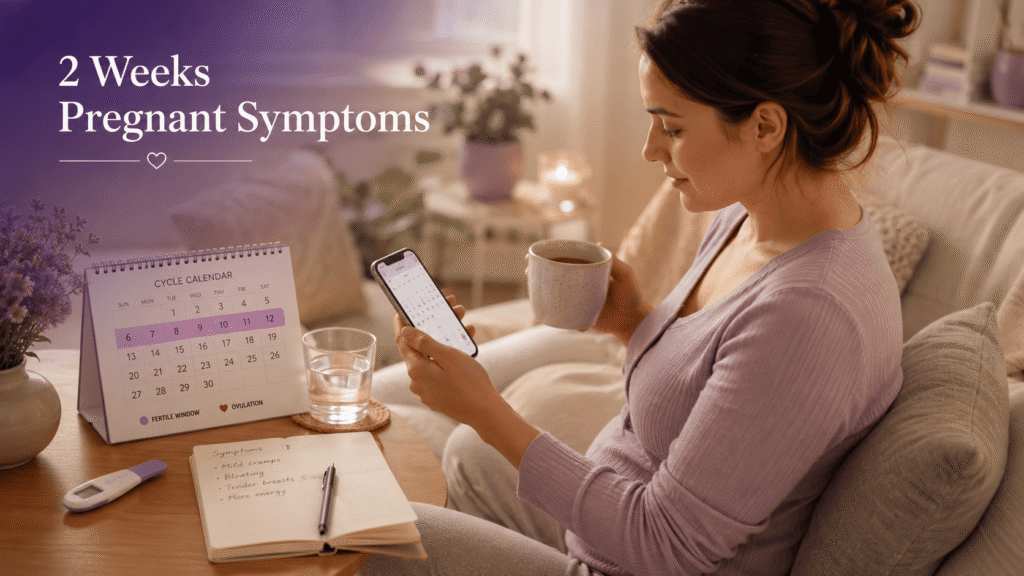
The most common 2-week pregnant symptoms are usually ovulation symptoms rather than signs of an established pregnancy. Since implantation has not normally happened yet, hCG is not available at a level that would reliably produce pregnancy symptoms.
You may notice:
- Mild pelvic cramping
- Clear, stretchy cervical mucus
- Breast tenderness
- Mild bloating
- Increased sex drive
- A small rise in basal body temperature after ovulation
- Very light spotting around ovulation in some cases
- No symptoms at all
Having no symptoms doesn’t mean anything is wrong. Many people notice absolutely nothing during this stage.
The tricky part is that normal menstrual hormones can create sensations that sound exactly like early pregnancy symptoms. Breast soreness, bloating, fatigue, and mild cramping can happen during ordinary cycles too.
How does your stomach feel at 2 weeks pregnant?
During pregnancy week 2, your stomach usually feels much like it does during another part of your menstrual cycle.
Some people experience mild bloating or a short-lived ache on one side of the lower abdomen around ovulation. A visible pregnancy belly is not expected because there is no developing fetus large enough to cause abdominal growth.
A sharp or severe pain deserves a different response. Contact a healthcare professional if pain is intense, persistent, worsening, or accompanied by heavy bleeding, dizziness, fainting, fever, or other concerning symptoms.
Don’t assume every abdominal sensation is related to ovulation.
What does discharge look like at 2 weeks pregnant?
During pregnancy week 2, discharge often becomes thinner, clearer, wetter, and more slippery as ovulation approaches.
Fertile cervical mucus may stretch between your fingers and resemble raw egg white. This change helps create an environment that supports sperm movement through the reproductive tract.
After ovulation, progesterone increases and cervical mucus often becomes thicker, cloudier, or less noticeable.
Normal fertile discharge may be
- Clear or slightly cloudy
- Slippery
- Stretchy
- More noticeable around ovulation
- Free from significant itching or burning
Get medical advice if discharge is
- Green or gray
- Strongly foul-smelling
- Associated with itching or burning
- Accompanied by significant pelvic pain
- Accompanied by heavy bleeding
Discharge alone cannot confirm pregnancy. During pregnancy week 2, fertile mucus is much more useful as a sign of ovulation than as evidence of conception.
What Should You Do and Avoid at Pregnancy Week 2?
Pregnancy week 2 is a useful time to shift toward pregnancy-safe habits if you’re trying to conceive. You don’t need to panic over every meal or turn your routine upside down.
Focus on the basics that have a clear health benefit.
What should you avoid at 2 weeks pregnant?
Healthy habits to follow during pregnancy week 2.
If pregnancy is possible, consider these practical precautions:
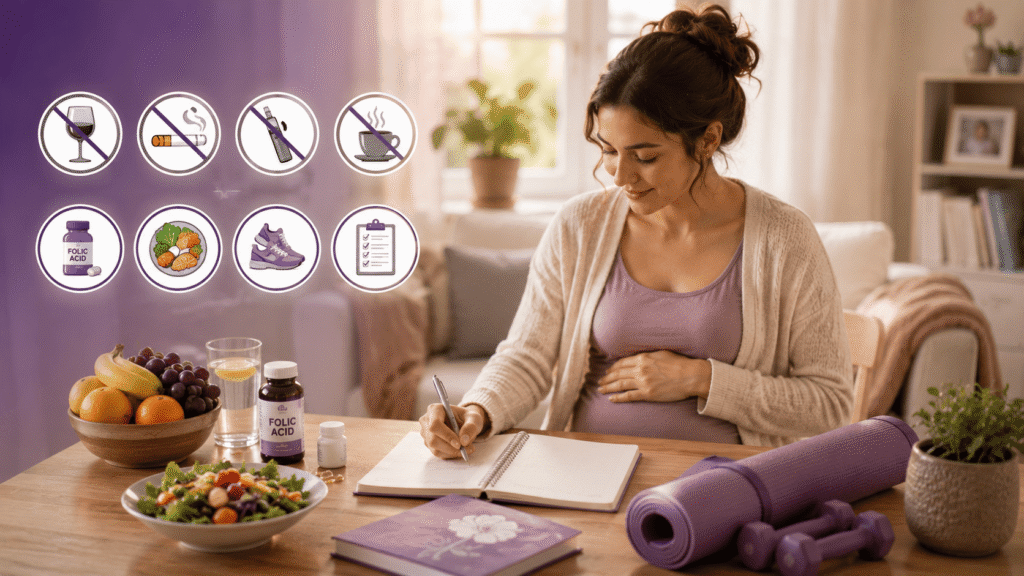
- Avoid alcohol. If you’re trying to conceive, skipping alcohol removes an avoidable exposure.
- Avoid smoking and nicotine products. Smoking can affect fertility and pregnancy health.
- Take folic acid. The CDC recommends 400 mcg daily for women who can become pregnant.
- Keep caffeine moderate. If you’re trying to conceive, following pregnancy caffeine guidelines is a reasonable approach.
- Follow food-safety precautions. Take care with unpasteurized foods and foods that carry a higher risk of foodborne illness.
- Review medicines and supplements. Ask your clinician or pharmacist about regular medications rather than stopping them yourself.
- Keep routine activity going. Normal exercise is generally compatible with trying to conceive unless your clinician has given you specific restrictions.
Folic acid deserves particular attention because neural tube development occurs very early, often before someone knows they’re pregnant; follow the CDC guidelines on folic acid supplementation of 400 mcg daily for anyone who can become pregnant. People with certain medical histories may need a different dose under medical supervision.
What should I do if I’m 1 or 2 weeks pregnant?
If you’re around pregnancy week 1 or pregnancy week 2 and trying to conceive, concentrate on preparation rather than pregnancy symptom hunting.
A sensible checklist looks like this:
- Start or continue a prenatal vitamin containing folic acid.
- Learn roughly when you ovulate.
- Have sex during the fertile window if you’re trying to conceive.
- Review prescription medicines with your healthcare provider.
- Avoid alcohol, smoking, and nicotine.
- Keep meals varied and nutritious.
- Continue normal physical activity unless you’ve been given different medical advice.
- Arrange preconception care if you have a medical condition or take regular medication.
For people over 35, fertility planning may also deserve earlier attention. ACOG recommends infertility evaluation after six months of trying for women older than 35, while those older than 40 may benefit from discussing evaluation with an ob-gyn sooner.
That doesn’t mean something is wrong if conception hasn’t happened quickly. It simply gives you a clearer point at which professional guidance can help.
📖 Complete Pregnancy Roadmap
Planning ahead for the journey to come?
Get a complete overview of key milestones, essential screenings, and antenatal care in our comprehensive guide.
When Should You Take a Pregnancy Test?
Track pregnancy week 2 symptoms and your fertile window.
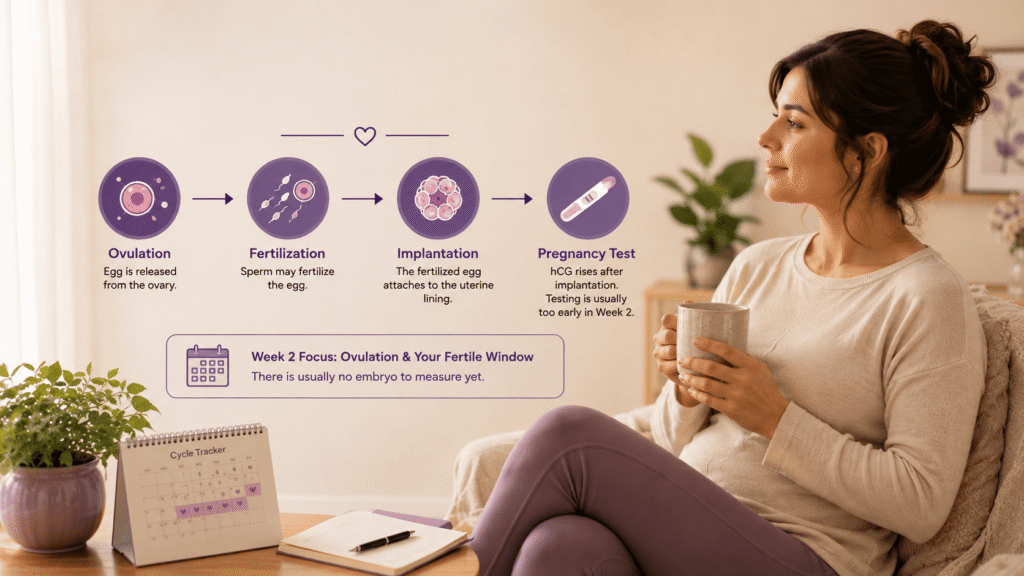
A pregnancy test during pregnancy week 2 is usually too early to tell you anything useful.
Home pregnancy tests detect hCG, which begins appearing after implantation. Since implantation occurs after fertilization, a test taken around ovulation or immediately afterward can be negative even if conception eventually occurs.
Most home pregnancy tests are most reliable from the first day of a missed period. If you don’t know when your period is due, follow the NHS guidelines on when to take a pregnancy test and test at least 21 days after your last unprotected sex.
Why Can an Early Test Be Negative?
A negative result can simply mean the test was taken before enough hCG had accumulated to be detected.
The process happens in stages:
- Ovulation: An egg is released from the ovary.
- Fertilization: Sperm may fertilize the egg after ovulation.
- Early cell division: The fertilized egg begins dividing as it travels toward the uterus.
- Implantation: The developing embryo attaches to the uterine lining.
- hCG production: After implantation, the body begins producing hCG.
- Positive pregnancy test: Once hCG reaches a detectable level, a home pregnancy test may show a positive result.
Testing during pregnancy week 1 or pregnancy week 2 usually happens before this process has progressed far enough for a test to detect pregnancy.
If you get a negative result but your period still doesn’t arrive, repeat the test after several days. If your cycle is unusually irregular or you have ongoing concerns, speak with a healthcare professional.
Can pregnancy symptoms start immediately after conception?
Usually, symptoms cannot reliably identify pregnancy immediately after conception.
The body needs time for implantation and rising hCG. Feeling a cramp or noticing breast tenderness shortly after sex doesn’t prove that fertilization occurred.
This is one reason symptom spotting can become frustrating during the two-week wait. The same sensations can occur in a normal menstrual cycle.
Is 2 Weeks Pregnant Actually 4 Weeks?
No. Pregnancy week 2 is not 4 weeks of pregnancy.
The confusion comes from the difference between gestational age and the actual timing of fertilization.
Doctors generally calculate gestational age from the first day of your last menstrual period. Conception typically happens roughly two weeks later in a regular cycle. So the pregnancy calendar includes time before conception.
| Pregnancy timing | What is usually happening |
|---|---|
| Pregnancy week 1 | Menstruation usually begins the pregnancy calendar |
| Pregnancy week 2 | Ovulation may be approaching or occurring |
| Pregnancy week 3 | Fertilization and early cell division may occur |
| Pregnancy week 4 | A missed period and positive pregnancy test may occur |
This also explains why pregnancy week 1 and pregnancy week 2 don’t involve an embryo in the usual sense.
Cycle length changes the exact timing. Someone with a shorter cycle may ovulate earlier, while someone with a longer cycle may ovulate later.
What is the two-week wait?
The “two-week wait” is the common name for the period between ovulation and the expected period.
For someone trying to conceive, it can be an oddly long stretch of calendar days. You may notice breast tenderness, cramps, mood changes, discharge, or nothing at all.
None of those signs can reliably confirm pregnancy before an appropriate test.
The waiting can be frustrating, especially when you’re checking every little symptom. I’d keep your attention on things you can actually control: taking folic acid, following healthy routines, and testing at the right time.
Pregnancy Week 1 vs Pregnancy Week 2
Pregnancy week 1 and pregnancy week 2 are both part of the 40-week pregnancy calendar, but they represent different points in the menstrual cycle.
During pregnancy week 1, the first day of your last menstrual period starts the gestational clock. By pregnancy week 2, estrogen and LH are helping prepare the body for ovulation.
| Stage | Main event | Is there usually an embryo? |
|---|---|---|
| Pregnancy week 1 | Menstrual bleeding | No |
| Pregnancy week 2 | Ovulation and fertile window | Usually not. |
| Pregnancy week 3 | Fertilization and early development | An early embryo may begin developing |
| Pregnancy week 4 | Possible missed period and positive test | Early pregnancy may be established |
Understanding pregnancy week 1 makes the week 2 timeline much easier to follow. If you want to revisit the previous stage, use the guide below.
🌸 Explore Early Pregnancy Care
Want to review how your cycle timeline started?
Learn how menstrual dating works and what to track from day one in our guide:
What Happens Next in Pregnancy Week 3?
Pregnancy week 3 is where the biological story can finally catch up with the pregnancy calendar.
If sperm fertilizes the egg, the fertilized egg begins dividing as it travels through the fallopian tube toward the uterus. At this point, the developing pregnancy is microscopic, so you won’t feel the embryo moving or growing.
Implantation happens later, after the early cells reach the uterus. hCG begins to rise after implantation, which is the reason pregnancy tests become useful later rather than during pregnancy week 1 or pregnancy week 2.
For someone trying to conceive, week 3 can still feel completely normal. You may have no symptoms at all.
Conclusion
Pregnancy week 2 is mainly about ovulation and the possibility of conception. Even though the medical calendar already calls it pregnancy week 2, there is usually no embryo to measure yet.
The most useful things to focus on are straightforward: understand your fertile window, take 400 mcg of folic acid daily, avoid alcohol and nicotine, review regular medications with your healthcare provider, and don’t rely on symptoms to confirm pregnancy. Testing during pregnancy week 1 or pregnancy week 2 is generally too early, so waiting until the appropriate testing window can save you unnecessary confusion.
If you’re moving through the series, pregnancy week 3 is the next stage, when fertilization and early development may begin.
And if you already have a positive test, have ongoing health concerns, or simply want a personalized pregnancy plan, book your trimester checkup with your healthcare provider rather than trying to work everything out from symptoms alone.

Track Your Fertile Window & Plan Ahead
Ready to optimize your timing? Connect with our team to map out your ovulation timeline, discuss preconception health, and get personalized guidance on your journey to conceiving.
Healthy Mother • Calm Mind • Healthy Baby
📍 Location: SA 6/168 Old RTO Office Chauraha, Sarnath, Ganapati Nagar, Ashapur Road, Pahariya, Sarnath-221007, Uttar Pradesh
📞 Contact: +91 96822 22121
✉️ Website: vedicpregnancy.com
🕒 Hours: Open 24 Hours
Frequently Asked Questions
Can you have twins if you’re only 2 weeks pregnant?
Yes, twins can eventually develop from two fertilized eggs or from one fertilized egg that later divides. At pregnancy week 2, though, it’s far too early to know whether a future pregnancy will involve one embryo or more.
Can stress prevent pregnancy during one cycle?
A stressful day does not automatically prevent conception. Long-term stress can affect sleep, eating patterns, and menstrual cycles, so persistent stress that affects your health is worth discussing with a healthcare professional.
Does having sex at night increase the chance of pregnancy?
There is no strong evidence that a particular time of day improves conception. The fertile window around ovulation matters much more than whether sex happens in the morning, afternoon, or evening.
Should you change your skincare routine while trying to conceive?
Some prescription and high-strength skincare ingredients may need review before pregnancy. Ask a dermatologist, pharmacist, or pregnancy care professional about specific products rather than stopping medically necessary treatment without advice.
Can you get an ultrasound during pregnancy week 2?
Usually, an ultrasound at this point cannot show an embryo because ovulation or fertilization may not have happened yet. Ultrasound timing depends on your cycle dates, symptoms, fertility treatment, and the reason for the scan.
When should you book a trimester checkup?
Once pregnancy is confirmed, contact your maternity care provider to arrange your first prenatal appointment. Timing varies based on your health history, local care practices, and any symptoms that require earlier assessment.
Can you become pregnant if you have sex several days before ovulation?
Yes. Sperm can survive for several days inside the reproductive tract, so sex before ovulation can result in pregnancy. ACOG describes the fertile window as extending across several days around ovulation.
Is it normal to have no symptoms during pregnancy week 2?
Yes. Pregnancy week 2 often has no recognizable pregnancy symptoms because conception and implantation may not have occurred. Lack of symptoms does not predict whether conception will happen.
Pingback: Pregnancy Week 1: Baby's Size, Your Symptoms and What to Do